Which Junctions Actually Move Your SAP Score - Our Junction-Impact Review
Not every junction is worth calculating. Before you commission anything, we rank your details by how much each one adds to the dwelling's heat loss, so you spend on the handful of junctions that move the SAP result - and leave the rest on conservative defaults.
14 July 2026 · 7 min read
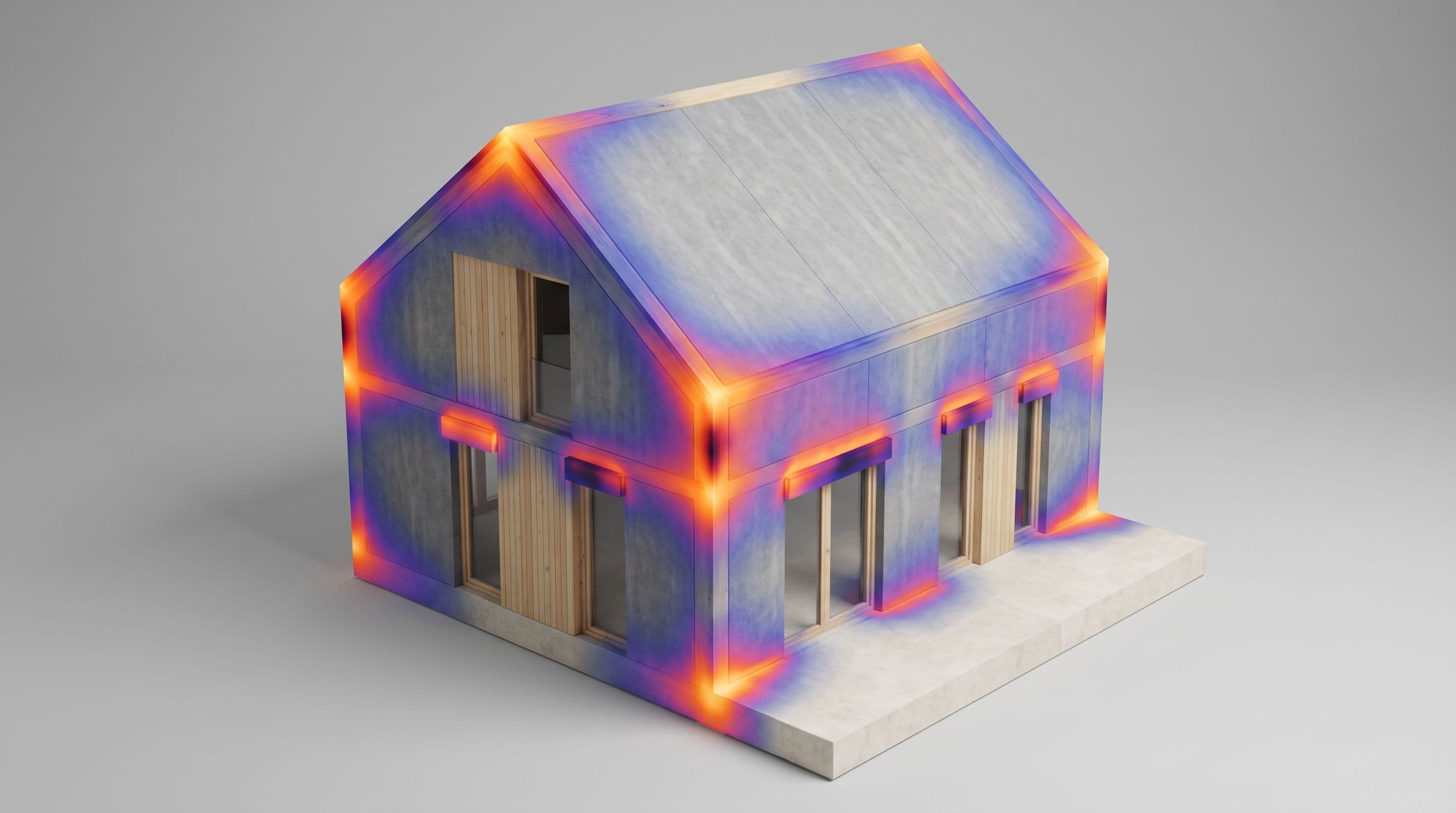
How junctions reach your SAP score
Every dwelling loses heat at its junctions - the lines where wall meets floor, wall meets roof, and the frame meets the reveal, head and sill around each opening. SAP accounts for this in Table K1, which lists every junction type with a reference code and a linear thermal transmittance (Ψ-value, W/m·K): the extra heat loss along one metre of that junction, over and above the plain elements either side.
Those Ψ-values roll up into a single term, the thermal-bridging heat-loss coefficient:
HTB = Σ (l · Ψ)
This is the length of each junction multiplied by its Ψ-value, summed across the whole dwelling. HTB adds directly to the fabric heat loss, which drives the space-heating demand, the Fabric Energy Efficiency rating and, ultimately, the SAP score and EPC band that decide Part L compliance.
Which junctions are worth calculating
SAP lets you enter thermal bridging two ways, and the gap between them is the whole point of this service:
- The default route applies a blanket y-value across the exposed envelope. It is deliberately punitive - SAP assumes worse-than-typical junctions precisely to discourage leaving them unassessed. That penalty is baked straight into the result.
- The calculated route replaces a junction's default Ψ with a modelled Ψ-value from a finite-element calculation, which is almost always lower. Each junction you calculate recovers part of the penalty on paper.
You can calculate the whole schedule, and for some projects that is exactly the right call - chasing the lowest possible SAP result, assembling a complete evidence pack for a certification scheme, or holding every detail to an in-house best-practice standard are all good reasons to model the lot. But you don't have to calculate everything to reach a strong SAP result, because the contributions are far from equal. HTB is dominated by a small number of junctions - those with the most linear metres (opening perimeters, eaves, corners and the ground-floor perimeter) or the highest Ψ-values. A short, well-detailed junction that appears twice in the whole building will never move the number, however much you spend modelling it.
So if the aim is the SAP score, the prize for calculating a given junction is roughly l × (Ψdefault − Ψcalculated) - long junctions with a wide gap between the default and a realistic modelled value. Rank the schedule that way and a handful of junctions usually deliver the overwhelming majority of the achievable saving; the rest can stay on conservative defaults with no meaningful penalty.
Heat loss isn't the only reason to model a junction, though. A detail can barely register in HTB yet still run cold enough on its inner surface to risk surface condensation and mould. That risk is set by the temperature factor, fRsi, and a junction that falls below the critical value - commonly 0.75 for dwellings, following BRE IP 1/06 and BS EN ISO 13788 - is worth calculating for the building's durability and the occupants' health, whatever its SAP weight. So we rank on two questions, not one: which junctions move the SAP result, and which carry a condensation risk. A detail can earn its place on the commissioning list for either reason.
What the review does
The Junction-Impact Review is the low-commitment first step, done before you commission any modelling. We take your drawings, build the junction schedule, estimate each junction's contribution to HTB, and flag any details whose geometry or build-up makes surface condensation a likely concern. You get back a ranked list that tells you exactly which junctions are worth calculating first - for heat loss, for condensation risk, or both - and which aren't worth touching. You commission the calculations from the top of the list and stop where the returns flatten out.
Our method
- Take off the junction schedule - from your architectural details, floor plans and elevations we identify every junction type present and measure its total length in the dwelling: metres of eaves and verge, perimeter of the ground floor, and the head/jamb/sill runs around every window and door.
- Assign a Ψ-value to each - the SAP Table K1 default (or an Accredited Construction Details value) for the uncalculated case, and a realistic target Ψ for the calculated case based on your build-up, so the gap - the recoverable saving - is visible for every junction.
- Compute each junction's HTB contribution - l · Ψ per junction, and its share of the total, so the picture is quantified rather than guessed.
- Rank by impact - order the schedule by recoverable saving (longest, most conductive, biggest-gap junctions first) and mark the cut-off point where further calculation stops paying its way, while separately flagging any junctions we'd calculate for surface-condensation (fRsi) risk regardless of their heat-loss weight.
- Recommend the commissioning list - the specific junctions to calculate, in priority order, with an estimate of the HTB reduction and the fixed fee to calculate each, so you can see the return before you spend.
An illustrative ranking
The output looks like this - figures shown are illustrative, not from your project:
| Rank | Junction | Length (m) | Ψ default | Contribution to HTB | Priority |
|---|---|---|---|---|---|
| 1 | Window/door perimeter (head, jamb, sill) | 46 | 0.05 | High | Calculate |
| 2 | Ground-floor perimeter (E5) | 28 | 0.16 | High | Calculate |
| 3 | Eaves (E10) | 22 | 0.06 | Medium | Calculate |
| 4 | External corner (E16, normal) | 11 | 0.09 | Low | Default is fine |
| 5 | Party wall to ground floor (P1) | 8 | 0.16 | Low-medium | Judgement call |
Here the openings and the ground-floor perimeter carry most of the recoverable loss simply because there are so many metres of them; the short corner run stays on its default because calculating it would cost more than it saves.
What you receive
A concise report: your full junction schedule with take-off lengths, the default and target Ψ-values used, each junction's contribution to HTB and its share of the total, and a ranked, priced commissioning list - the junctions to calculate first, in order, with the expected heat-loss reduction against the fixed fee. It turns "should we calculate our thermal bridges?" into a clear, costed decision, before any modelling is commissioned.
Pricing
The Junction-Impact Review is a fixed £100 (ex VAT) - a deliberately low-commitment entry point. It is waived if you go on to commission five or more junction calculations, so if the review sends you straight into a set of details, it effectively costs nothing. Individual 2D junctions are then charged at transparent fixed fees (from £125), confirmed before any work starts; 3D junctions are quoted on request. See the Thermal Bridging service page for the full fee schedule.
The standards we follow
- SAP 10 (Table K1) - the source of the junction reference codes, default Ψ-values and the HTB = Σ(l · Ψ) method that feeds the dwelling's heat-loss assessment and Part L compliance.
- BR 497 (BRE) - the UK conventions for linear thermal transmittance, external dimensions and consistent Ψ-value definitions that any subsequent calculation follows.
- Accredited Construction Details - the published Ψ-values used as the reference case where a junction is left uncalculated.
- BS EN ISO 10211 & BS EN ISO 6946 - the numerical calculation of junction heat flows and the U-values and surface resistances behind every Ψ-value, applied when the prioritised junctions are modelled.
- BS EN ISO 13788 & BRE IP 1/06 - the temperature-factor (fRsi) method and critical values used to judge whether a junction risks surface condensation and mould, so a cold detail can be prioritised for that reason even when its heat-loss contribution is small.
We supply the modelling inputs and the priorities behind them - the Ψ-values and reports your SAP assessor uses. We don't issue the SAP or EPC certificate itself.